Saturday, January 19, 2019

Monday, January 7, 2019
Education Statistics: Facts About American Schools
Education Statistics: Facts About American Schools
Jump to a Section: Schools and Districts | Students | Teachers and Principals | School Spending
How many K-12 public schools, districts, and students are there? What does the American student population look like? And how much are we, as a nation, spending on the education of these youth?
These data points can give perspective to the implications and potential impact of education policies. The Education Week library provides answers to these questions, and some other enlightening facts, below.
This page will be updated when new federal data becomes available.
SCHOOLS AND DISTRICTS
How many schools are there in the U.S.?
There are 132,853 K-12 schools in the U.S., according to 2015-16 data from the National Center for Education Statistics (NCES). Here's how they break down:
- All: 132,853
- Elementary schools: 88,665
- Secondary schools: 26,986
- Combined schools: 16,511
- Other*: 691
Here's what that looks like in chart form:
How many are traditional public schools, public charter schools, or private schools?
While charter schools are often the topic of debate, they make up only a small portion of all schools.
- Traditional public schools: 91,422 (2015-16, Source)
- Public charter schools: 6,855 (2015-16, Source)
- Private schools: 34,576 (2015-16, Source)
For more on charters, including how they work and who oversees them, read this explainer.
What is the average public school size?
The average public school enrollment is 526 students, according to data from 2015. That's up 6 students from the average school size in 2011, according to NCES.
What is the average public school size by type of location?
- City: 591 students
- Suburban: 657 students
- Town: 445 students
- Rural: 354 students
- (2015, Source)
How many school districts are there?
There are 13,584 regular school districts in the U.S. (2015-16, Source)
Note: Regular districts exclude regional education service agencies and supervisory union administrative centers, state-operated agencies, federally operated agencies, and other types of local education agencies, such as independent charter schools.
Where are the largest school districts in the U.S.?
Big cities like New York and Los Angeles lead the list of the largest school districts, as identified by NCES in 2015. But the rest of the top 10 may surprise you:
| Rank | District name | State | Enrollment |
|---|---|---|---|
| 1 | New York City | NY | 981,667 |
| 2 | Los Angeles Unified | CA | 639,337 |
| 3 | Chicago | IL | 387,311 |
| 4 | Miami-Dade County | FL | 357,579 |
| 5 | Clark County | NV | 325,990 |
| 6 | Broward County | FL | 269,098 |
| 7 | Houston | TX | 215,627 |
| 8 | Hillsborough County | FL | 211,923 |
| 9 | Orange County | FL | 196,951 |
| 10 | Palm Beach County | FL | 189,322 |
What's the average tenure of a big-city superintendent?
Superintendents in large cities stick around for an average of 6 years, according to a report by the Broad Center.
STUDENTS
How many students attend public schools?
In America's public schools there are 50.7 million students, based on federal projections for the fall of 2018.
How many students attend charter schools?
According to data from three years earlier, 2.8 million public school students, or 5.7 percent, are in charter schools.
How many students attend private schools? What are the religious affiliations of those schools?
In total, 5,750,520 students attend private schools, according to NCES 2015-16 data.
- 36.2% of those in Catholic schools
- 24.3% in nonsectarian (non-religious) schools
- 16.0% in un-affiliated religious schools
- 13.2% in conservative Christian schools
- 10.2% in other religiously affiliated schools
How many students are homeschooled?
There are 1,689,726 homeschooled students. That's 3.3 percent of all students, according to NCES 2015-16 data. After doubling between 1999 and 2012, the number of homeschooled students in the United States appears to have leveled off. So who are the nation’s homeschoolers? This overview of homeschooling includes more information on the topic.
Where do most students attend school—the city, the suburbs or rural areas?
According to 2015-16 data, the majority of public school students attend suburban schools, but enrollment in urban schools is not far behind.
- Suburban: 39.7% of public school students
- City: 30.2% of public school students
- Rural: 18.7% of public school students
- Town: 11.3% of public school students
Meanwhile, most private school students attend schools in the city.
- City: 43.0% of private school students
- Suburban: 40.2% of private school students
- Rural: 10.7% of private school students
- Town: 6.2% of private school students
What are the demographics of public school students?
Here's a racial breakdown of the student population in American public schools, as of 2015:
- White students: 48.9%
- Hispanic students: 25.9%
- Black students: 15.5%
- Asian students: 5.0%
- Two or more race students: 3.4%
- American Indian/Alaska Native students: 1.0%
- Pacific Islander students: 0.3%
The 2015-16 school year was the first in which the majority of public schoolchildren were minorities. For a look back at what that milestone meant for schools, revisit this story from 2014.
How many students graduate high school?
The national graduation rate is 84 percent, according to the latest data.
How has that changed over time?
The graduation rate has increased by 5 percentage points from 2010-2011 to 2015-2016. What's behind record rises in U.S. graduation rates? More on that here.
How many students graduate in my state?
Hover over a state in this interactive map to see its graduation rate, broken down by demographic groups:
TEACHERS AND PRINCIPALS
How many teachers are there in the U.S.?
In America's public schools there are 3.2 million full-time-equivalent teachers, according to federal projections for the fall of 2018.
How many principals are there?
There are 90,410 public school principals in the U.S., according to 2015-16 data from NCES.
What percent of teachers are women?
Teaching continues to be a profession dominated by women. According to 2018 projections from NCES 76.6 percent of teachers are female, while 23.4 percent are male.
What are the racial demographics of teachers?
When it comes to race, America’s teachers looks very different from its student population.
- 80.1% White
- 8.8% Hispanic
- 6.7% Black
- 2.3% Asian
- 1.4% Two or more races
- 0.4% American Indian/Alaska Native
- 0.2% Native Hawaiian/ Pacific Islander
- (2015-16, Source)
For a more detailed look at the profile of America’s teaching force, including average age and years of experience, read this report on the latest federal data.
Who are U.S. public school principals?
Like teachers, most American principals are white and female.
- 54.2% Female
- 45.8% Male
- 77.8% White
- 10.6% Black
- 8.2% Hispanic
- 1.4% Asian
- 1.1% Two or more races
- 0.7% American Indian/Alaska Native
- 0.2% Native Hawaiian/ Pacific Islander
- (2015-16, Source)
Another finding from the latest federal data: Charter school principals are more diverse. Read more.
What's the average U.S. teacher salary?
The average base salary for teachers is $55,100, according to 2015-16 data from NCES. Of course, teacher salaries vary widely from state to state. Although its findings differ from the federal data, the National Education Association, the nation's largest teachers' union, releases an annual ranking of state salaries. Here are the latest numbers.
How does that compare with principals' salaries?
According to data from the same year, the average principal salary is $95,700.
How big are the teachers' unions?
According to NCES data from 2015-16, 69.9 percent of teachers are members of a union.
As of April 2018, the National Education Association has 3,018,492 members who are active educators or retirees.
As of October 2017, the American Federation of Teachers has 1,591,911 members.
What is the average student to teacher ratio in schools?
On average, there are 16 students assigned to a single teacher, NCES projections for fall of 2018 show.
The state with highest student to teacher ratio is, as of 2015, California, with 23.9 students for each teacher. The state with lowest student to teacher ratio? Vermont, with 10.5 students for each teacher.
Note: The pupil/teacher ratio includes teachers for students with disabilities and other special teachers, while these teachers are generally excluded from class size calculations.
SCHOOL SPENDING
How much does the U.S. spend on K-12 education?
In 2014-15, $625 billion was spent on public elementary and secondary education by local, state, and federal agencies.
How much is spent per pupil?
Education Week examines per-pupil spending as part of its annual Quality Counts report. On average, the nation spends $12,536 to educate each student. These expenditures vary state to state. Vermont has the highest per-pupil expenditures in the nation at $20,795, as adjusted for variations in regional costs. At the other end of the scale, Utah spends the least at $7,207 per student.
Hover over a state to see its per-pupil spending, as adjusted for regional cost differences:
Have more education statistics you’d like to see on this page?
Scroll down or click here to drop us a comment with your suggestions or feedback.
Sunday, November 4, 2018
Critically analyze Ron Clark's "Essential 55" rules
For an exercise on dominance and clueless presumptions masquerading as best practice, critically analyze Ron Clark's "Essential 55" rules. See attached image. Easier to read PDF at https://t.co/uKolSf9foz. New addition to my PD work. pic.twitter.com/62zJ9kcauN— Paul Gorski (@pgorski) November 4, 2018
Wednesday, October 31, 2018
Monday, October 29, 2018
Commentary:
When college students are afraid to speak up
Stephen CarterBloomberg View
Survey shows about half of college students are afraid to speak up when their peers disagree with them
Maybe I'm a mite overconcerned about the findings of the just-released survey by McLaughlin & Associates about the attitudes of college students toward free speech. The survey, conducted during September on behalf of Yale University's William F. Buckley Jr. Program, found some disturbing responses on basic questions about just how free students think their own campus speech is.
Before I begin, a word of caution. Young people nowadays are notoriously difficult to sample. The survey was conducted online, and the data were stratified "to reflect the actual demographic composition of undergraduate students in the United States," as reported by the federal government. But this adjustment cannot account fully for selection bias. Nevertheless, the report brings not entirely happy news for those who care about the quality of campus debate.
I'll start with the good stuff. Most students surveyed (73 percent) don't want to scrap the First Amendment. True, a depressing 30 percent of self-described liberals think it's time to rewrite the amendment's guarantee of free speech. But I suspect the Constitution will survive their displeasure.
Second, only 10 percent think that their colleges should go further in regulating speech, although there the question seems to me fairly loaded, I assume unintentionally, against regulation. (And I say this as one who thinks regulation of speech on campus, however well-intentioned, is a terrible thing, bound to end in disaster.) In addition, only 16 percent of students say debate should be more restricted at the college level than in the society at large. Some 38 percent say debate should be less limited, and 43 percent say there should be no difference.
The third happy result is that overwhelming majorities reported that their own professors tolerate diverse opinions in the classroom. In fact, the figure was over 80 percent in every demographic group except part-time students, and even there the figure was 72 percent.
From there, however, things get worse.
The survey asked whether students felt intimidated about sharing their own views because they differed from either the views of their professors or the views of their classmates. On both questions, respondents split almost evenly. That roughly half of students feel that professors sometimes don't welcome their dissent is unwelcome news. But we learn more if we probe the data more deeply. Republicans were slightly more likely than Democrats to have experienced classroom intimidation, and men were slightly more likely than women. The outlier group, by a significant margin, is Hispanic students, of whom some 56 percent report feeling intimidated, compared with 49 percent of black students and 45 percent of white students.
Recent research has indicated that peers play a more important role than professors in pressuring college students to change their views. So when the survey moves from intimidation in the classroom to intimidation by peers, we should see a shift. And we do. For example, there is suddenly a significant difference between reports of intimidation by students aged 22 and under (53 percent) as against older students (48 percent) — a distinction that might have more to do with maturity than politics. Interestingly, we also learn that although 54 percent of students at four-year colleges report peer intimidation, the figure at two-year colleges is only 42 percent.
More intriguing still is that students who self-identify as political independents are significantly less likely than those who self-identify as Republicans or Democrats to report intimidation by either professors or peers. Put otherwise, independents seem willing to speak up and take the flak. This phenomenon seems to me to have a common sense explanation. A highly partisan student is more likely to spend large amounts of time in the company of other highly partisan students — and partisans, especially nowadays, don't like to be disagreed with. Indeed, suppressing one's own urge to dissent is part of how one signals membership in a group. In other words, what might be causing Democrats and Republicans to feel intimidated is their tendency to hang around with fellow Democrats and Republicans.
Still, the intimidation findings are depressing. Essentially half of college students say they are afraid to speak up when their peers disagree with them. This may be a sign that young people are in some fundamental sense weaker than earlier generations, but we can't tell, because we have no reliable survey data from, say, 40 years ago. Or perhaps it's a sign that critics are correct, and things have changed fundamentally on campus.
The survey's most counterintuitive finding might be that although a plurality of students (37 percent) thinks their school is more tolerant of liberal than conservative beliefs, self-described liberals (at 51 percent) are far more likely than self-described conservatives (at 35 percent) to believe this. Could it really be, despite all the hype about political correctness, that conservatives are less intimidated on campus than liberals?
Maybe this result isn't so surprising. Let's look at two plausible explanations.
First, it may be that students at four-year colleges are more likely than students at two-year colleges to be liberal. Given that the study finds students at two-year colleges report less intimidation overall, the data might actually be picking up the difference in who's enrolled where.
Second, liberal and conservative students are unlikely to be equally represented in all majors or, within a major, in all courses. It's possible, then, that more liberal students self-select into exactly the sort of courses where dissent is less tolerated.
I'm not embracing either explanation. I'm just pointing them out as plausible candidates.
Overall, there's good news and bad. It's refreshing to learn how few students support restrictions on campus speech. At the same time, it's depressing to learn how many don't feel free to speak up when they disagree with faculty or peers. Those of us who dwell in the academy should celebrate the first and do what we can to remedy the second.
Bloomberg View
Stephen Carter is a Bloomberg View columnist and a law professor at Yale.
53% of US undergrads afraid to disagree with outspoken professors on political, social issues — poll
53% of US undergrads afraid to disagree with outspoken professors on political, social issues — poll
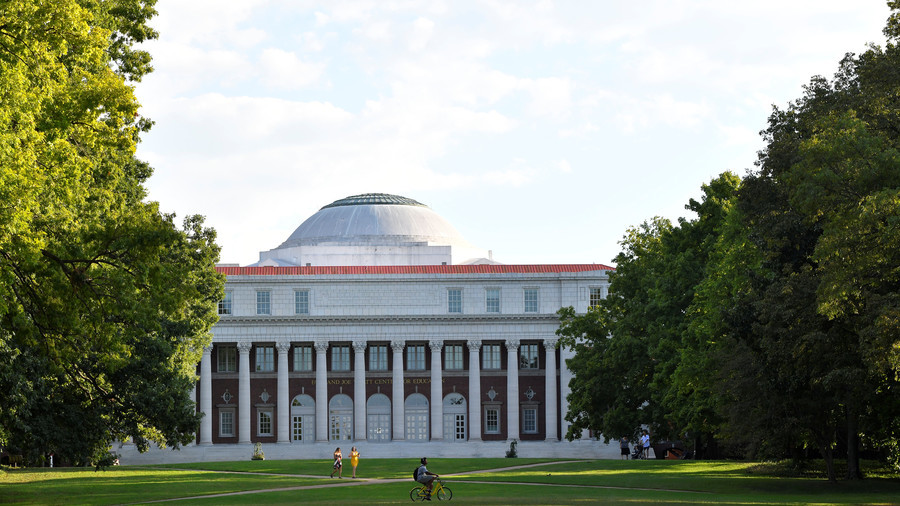
US college campuses have traditionally been known as havens of free speech among students, but now professors are increasingly sharing their opinions — and many undergraduates are afraid to disagree with them, a new survey found.
Some 800 full-time undergraduate students at private and public four-year universities took part in the survey earlier this month that was conducted by McLaughlin & Associates on behalf of Yale University's William F. Buckley, Jr. Program.
More than half of those students (52 percent) said that their professors or course instructors express their own unrelated social or political beliefs "often" in class, according to the poll results that are due to be released next week, but were seen in advance by The Wall Street Journal found.
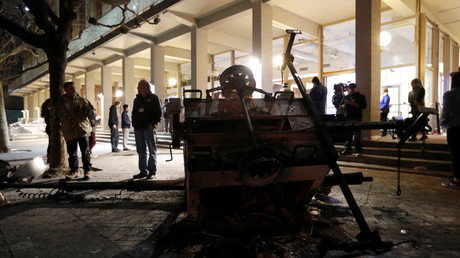
But unlike their professors, the young people find it more difficult to speak up. The survey found that 53 percent of the students polled often feel "intimidated" in sharing their ideas, opinions, or beliefs if they differ from their professor's. That's an increase of four percentage points from three years ago.
The students were also asked about hate speech on campuses, with 33 percent believing that physical violence can be justified to stop a person from making hateful or racially charged comments. That number represents a slight increase from last year, when 30 percent of students said the same.
Meanwhile, when asked about the First Amendment, which protects free speech in America, 17 percent of students said they would stand behind a rewrite of it, as they consider it "outdated."
While the poll doesn't specify which direction each professor's personal opinions lean, a survey conducted earlier this month by a politics professor at Sarah Lawrence College provides insight on the political affiliations of student affairs administrators in the US. A whopping 71 percent identified as liberal or very liberal, while only six percent identified as conservative to some degree.
"To students who are in their first semester at school, I urge you not to accept unthinkingly what your campus administrators are telling you. Their ideological imbalance, coupled with their agenda-setting power, threatens the free and open exchange of ideas, which is precisely what we need to protect in higher education in these politically polarized times," the study's author, Samuel J. Abrams, warned in a column in The New York Times.
Freedom of speech on America's college campuses has, according to many conservatives, long been under threat. The University of California at Berkeley has constantly found itself at the heart of the controversy.
The Berkeley campus, historically and currently known for its liberal students and staff, was at the center of clashes and arrests last year as protesters and counter-protesters came out in full force to make their voices heard over a talk by the former editor of conservative online news site Breitbart.
Berkeley also came under fire for canceling a planned speech by conservative pundit Ann Coulter last year, with some students even filing a lawsuit over the matter.
The behavior of the university, which is ironically the home of the Free Speech Movement, even evoked a response from US President Donald Trump, who threatened to pull its federal funding if it didn't change its tune.

But Berkeley isn't the only campus to make headlines for its treatment of conservative speakers. Texas Southern University in Houston canceled a commencement address by Republican Senator John Cornyn last year, after a petition was filed against his appearance by students.
Subscribe to:
Posts (Atom)